Kripke resigns as report alleges he faked results of thought experiments
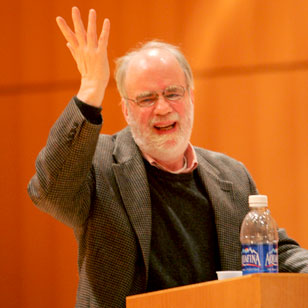
“Did I tamper with the results? It’s possible.” Uttered by anyone else, this would be a damaging admission.
Saul Kripke resigned yesterday from his position as Distinguished Professor of Philosophy at the CUNY Graduate Center. While similar allegations have been circulating in unpublished form for years, a team of philosophers from Oxford University has just released a damning report claiming that they were systematically unable to reproduce the results of thought experiments reported by Kripke in his groundbreaking Naming and Necessity. The team, led by Timothy Williamson, first became suspicious of Naming and Necessity after preliminary results raised questions about related work by Hilary Putnam. While the group was initially unable to confirm that water is H2O on Twin Earth, the results turned out to be due to contaminated research materials—one of the researchers’ minds had been contaminated by Chomskyan internalist semantics.
The inability to replicate Kripke’s results could not be similarly explained away, however, as the researcher in question was excluded from the analysis of Naming and Necessity. The report, forthcoming in Philosophical Studies, claims that 74% of the book’s thought-experimental results could not be reproduced using the standard philosophical criteria for inter-researcher agreement. A second version of the analysis, employing a generous application of the principle of charity, still left 52% of the results unverified.
Post at Philosodogs
I’ve got a post over at Philosodogs, ripping off coauthored with WeRateDogs and Jean-Paul Sartre. Check it out.

Magical Gourmet Report: House Prefects
From the quill of Eli Shupe (Intern at the Ministry of Magic)
If your Philosophy Department were a Hogwarts House, which one would it be? The results of the survey are in! Here are the House Prefects, i.e. the schools most strongly affiliated with the four Hogwarts Houses. Like all the most important announcements, this one comes in the form of commemorative desktop wallpaper.

Congratulations to…
MIT (classified by 45% of respondents as Ravenclaw)
Brown University (48% Hufflepuff)
University of North Carolina (31% Gryffindor)
New York University (62% Slytherin)
Towards a Theory of Food Categorization
Forthcoming in the Proceedings of the Society of Drinking a lot of Cough Syrup
“Everybody knows that something is wrong. But it is uniquely the achievement of contemporary philosophy – indeed, it is uniquely the achievement of contemporary analytical philosophy – to have figured out just what it is. What is wrong is that not enough distinctions are being made.”—Jerry Fodor[1]
There has been a much-needed resurgence in published papers and PhD dissertations on the philosophy of food categorisation. Yet, outside of the philosophy department, we are steadfastly entrenched in a naïve tradition that does little but separate food from drink. The recent attempts at popularizing food categorisation are inadequate at capturing the natural distinctions, and have barely engaged with the emerging philosophical literature. For example, the philosopher Lawson, in her seminal thesis “Nigella Bites”[2], invoked the categories “slow cook weekend”, “comfort food”, and “rainy days”, which critics claim offer an embarrassment of riches that fail to ‘carve nature at its joints’. This paper will clarify the emerging philosophical consensus, and suggest possible avenues for further research.
The Magical Gourmet Report
From the quill of Eli Shupe (Intern at the Ministry of Magic), with assistance from Cameron Domenico Kirk-Giannini and Cherie Braden (House Elves).
If your Philosophy Department were a Hogwarts House, which one would it be? While armchair speculation on this important issue has yielded little real progress, cutting-edge approaches developed by experimental philosophers promise to settle matters once and for all!
Witches and wizards may take the survey here. (Remember, the Houses exemplify different virtues. Slytherin has been unfairly maligned over the years, but there’s nothing intrinsically wrong with cunning and ambition.)
An overall results page that magically updates as opinions trickle in may be found here. Close statistical analysis of the relation between self- versus other-perceived House affiliations to follow. The school most strongly associated with each House at the end of data collection will be officially named the Prefect of that House.

Disclaimer: Apart from your own department, you will only be able to evaluate the top twenty-ish departments of a certain well-known muggle system of rankings. Apologies to those who are left out of the hijinks — you are more than welcome to create and disseminate a more inclusive version (which we will be happy to link to).
Woman discovers husband is cleverly disguised mule

Robert Mills in an undated photograph
The following is an excerpt from the forthcoming book Till the Skeptical Hypothesis Do Us Part: Philosophical Advice for a Veridical Marriage, by Martha Slattery.
In 2012 Mary Mills learned that Robert, her husband of six years, was a cleverly disguised mule. The surprising discovery was made when Mary and Robert visited a doctor for infertility testing. The doctor checked to see if there was a genetic cause of infertility and sure enough there was. Mary had 46 chromosomes, Robert had 63. They soon divorced.
This tragic outcome could have been prevented. Remember, the key to a successful marriage is being the same natural kind as your partner. Don’t rush things — have that special someone checked out by a good veterinarian before you tie the knot.
Monism special issue
 Some questions just don’t seem to go away. Why is there something rather than nothing? Do we have free will? How many things are there? In this issue of the Proceedings of the Society of Drinking a Lot of Cough Syrup, we take up this last question and explore an underdeveloped answer. Monism: because counting is hard.
A Simple Argument for Existence Monism
Cameron Domenico Kirk-Giannini and David Black
Some say that there is more than one object. It might seem, for example, that my table is one and my chair is one, so together they are more than one — they are two ones. But suppose for reductio that there is more than one one. Then the ones are not one. But one cannot be not one. So there is only one one.
Advice

Philosophers are badasses. Don’t let anyone tell you otherwise.
It’s grad-application season again, so this seems like an appropriate time to share a few words of advice with the next crop of philosophers. And now that I’m a second-year graduate student myself, I think I’m ready to start making sweeping generalizations about the field.
First, philosophy has a bad rap these days. Some say it’s just intellectual masturbation — that you’ll spend your life engaging in an activity that you find stimulating but that will never produce anything of value.
I don’t think that’s right. Typically masturbation stays between you and the occasional family member who’s unfortunate enough to open the door without knocking. Philosophy, by contrast, is meant to be shared.
Show me your papers, eh?
The following is an editorial by guest author Gerald Mueller, the Strom Thurmond Chair of Conservative Thought at the University of Cascadia.
Rule breaking!!
Last time I wrote about babies. They’re milking this country for all it’s worth and we all know it. But you probably haven’t heard about the second major threat facing our economy: Immigrants. Yes, immigrants. And I’m not talking about the kind that God sends to subdue a wild and fertile continent — those days are over. I’m talking about the kind of immigrant that sneaks across your border and steals your job without so much as asking.
Pretty much everything I said about babies goes for immigrants as well. They steal our jobs, feed at the public trough, and don’t pay taxes. And the worst of them even come over here and make more babies. So I’ll get right to the nub of the issue: What are we going to do about it?
Proceedings, issue 2
Thanks to a little ingenuity and a lot of plagiarism, the Proceedings of the Society of Drinking a lot of Cough Syrup is back with a second issue. The contents are as follows.
 Moving Forward by Reading Backwards and Forwards
Ben Bronner and Anonymous
Wittgenstein said that philosophy is a battle against the bewitchment of our intelligence by means of our language. We argue that perhaps the most bewitching aspect of our language is its left-to-right structure, which subtly insinuates that the world which it pictures also possesses a left-to-right structure, a privileged direction. The solution, of course, is that philosophy should be written solely in palindromes. Some claim this stricture would inhibit genuinely philosophical discussion, to which we respond: Do geese see God?
A new philosophy journal

I am pleased to announce the first issue of the Proceedings of the Society of Drinking a Lot of Cough Syrup. Interested readers may find the Proceedings wherever philosophy journals are sold. The contents of the first issue are as follows.
Journey to the Center of the Earth
If ghosts exist, then where is the evidence? I answer this question by arguing as follows. If ghosts exist, they are subject to the force of gravity. Since ghosts can pass through walls, they would likewise (under the force of gravity) pass through floors. Where would the ghosts go? Clearly to the Earth’s center of mass. This argument shows that, in a normal Bayesian model, the fact that we don’t see any ghosts actually makes it more likely that there really are ghosts.
Justice Thomas reveals elaborate reductio of “money = speech”
[The quotations attributed below to Justice Thomas are genuine (though not the picture caption, obviously). Thanks to Alex Guerrero for the quip which inspired this post and became its title.]

“You thought I was serious, didn’t you?”
This week’s ruling in McCutcheon v. Federal Election Commission confirms what many have suspected since 2010’s Citizens United: Justice Clarence Thomas is engaged in an elaborate reductio of the idea that money is speech.
In Citizens United Justice Thomas argued that if political expenditures by corporations and unions are speech (as claimed by the Court), then existing disclosure requirements are unconstitutional. Such requirements, Thomas wrote, would violate the right to anonymous speech.
But Thomas’s position on the matter was too extreme even for Justices Roberts, Scalia, and Alito, leading some to suggest that Thomas had unknowingly produced a reductio ad absurdum of the idea that corporate political expenditures are speech. Others responded that Thomas was well aware of the reductio he had crafted, and the proper interpretation of his intentions remained controversial.
The Pipe You Can Save

Roger Scruton wants to know why you hate freedom.
[The following is a “guest post” by Roger Scruton. Actual passages from Mr. Scruton’s columns in The Wall Street Journal appear in quotes, followed by links to the original articles.]
Each day 19,000 children die from preventable, poverty-related causes. For the vast majority of these children, their early death means that they will never have the chance to take up smoking. And if the World Health Organization has its way, the number of such tragedies will only increase.
The WHO is aggressively pursuing anti-smoking policies in the developing world. Measures range from excise taxes to warning labels to complete bans on advertising. “This despite the fact that tobacco-smoking has not been identified as the sole cause of any of the diseases associated with it.” [1] “Of course tobacco, used to excess, can damage one’s health.” But “what do we mean by health? The average smoker gains mental relaxation, social confidence and an easy form of hospitality from his habit: are these not parts of health? And are we necessarily right to trade them for a few extra years of life, when most of us live too long in any case?” [2]
Grad school

The king of France is ready for class.
So I haven’t posted a story in a while. Apologies for that. Now that I’m back in school my attention is elsewhere. But I figure I can at least share the more amusing bits of life in grad school. So here goes.
I always dress up for one class in particular. It’s called “Formal Philosophy.” My jokes are too subtle to be perceived by the human mind.
Speaking of formal philosophy, partial meat contraction is not what it sounds like. (Think swimming on a cold day.) Largely that’s because it sounds like “partial meat contraction” but it’s actually “partial meet contraction.”
I named my new cat ‘the king of France’. Originally I was leaning towards ‘Louis XIV’, but Bertrand Russell convinced me that ordinary names are just disguised definite descriptions. I figured I might as well get it out there in the open. Bonus: ‘The king of France is bald’ is unequivocally false. Take that, Strawson.
Obama releases philosophy from strategic reserve

“We’ve got all this unrefined crude and no one to process it,” President Obama told reporters this week, referring to the backlog of crude concepts awaiting refinement at the nation’s colleges and universities.
President Obama authorized the Department of Education on Monday to release 100,000 counterexamples from the Strategic Philosophy Reserve (SPR). The move follows worries that the nation’s friends, family members, and acquaintances are increasingly getting away with overgeneralizations, invalid inferences, and general bullshittery. This is the first release since 2010, when Obama tapped into the SPR in a failed attempt to head off $2,000-per-year subscription rates for Springer journals.
The broader context for the SPR release is provided by the nation’s ongoing philosophy work stoppage. The strike, which has spread to philosophy departments in all 50 states, is now in its fourth month with no end in sight.
Sean Hannity: Not even wrong, new report says

Sean Hannity doing what he does best: emitting noises from his gaping mouth-hole.
A report released by the Moral Philosophy Research Group this week confirms what many have long suspected: Sean Hannity’s commentary is entirely devoid of cognitive content. “Yes, except we mean it literally,” says Anthony Vega, the report’s lead author. “When Hannity utters a sentence, he’s not asserting a proposition that might be true or false – he’s simply expressing an attitude.”
The researchers first became interested in Hannity after noticing a startling contrast between his apparently successful use of language and what seemed to be a never-ending string of blatant falsehoods. “Most of what he says seems to be demonstrably false,” Vega notes, “and yet he engages in these back-and-forth exchanges in which his guests somehow just don’t seem to care. I found myself wondering: What if Sean Hannity isn’t even in the business of describing reality?”
Sexuality, reported actions, and the body: A refutation
[The following is a guest post by Clinton McGruff, written in response to recent events.]
What do you call a man who exposes himself to women for pleasure? A philosophy professor, of course. Why does this joke work? Because sexual harassment is so common in academic philosophy. But also because of the tension between the image of the lewd “flasher” (a certain type of harasser) and that of the staid professor. When you think about it, most times that you are naked it’s not even about sex: when you bathe, dress, or are examined by the doctor, for example. The ancient Greeks used to wrestle naked and artists still use naked models. Indeed, without the body human culture would not exist. So really the body is very respectable and vital to human flourishing. We are a corporeal species.
I have in fact written a whole book about the body, Pretension, in which its ubiquity is noted and celebrated. I even have a cult centering on the body, described in this blog. I have given a semester-long seminar discussing the body and displays related to it. I now tend to use nudity in the wide-ranging manner just outlined, sometimes with humorous intent.
Lawmakers blame philosophy for recent spate of trolley deaths

“This country doesn’t have a ‘trolley problem’. It has a philosophy problem.” Sen. Lamar Alexander
Lawmakers on Capitol Hill turned their attention to philosophy this week after Monday saw what appears to be the nation’s third trolley-related homicide since April. Members of both houses of Congress raised the prospect of legislation to regulate the violent content found in much contemporary moral philosophy, and Sen. Lamar Alexander (R-Tenn.) introduced a bill to study the effects of violent philosophy on children and adolescents.
The proposal comes in the wake of the death of Amtrak employee Charles Shubin, who was killed Monday when a runaway trolley was diverted onto the side-spur to which Shubin had been tied by unknown individuals. Two trolleys involved in similar incidents in April turned out to have had their brake lines cut.
John Searle’s homunculus announces phased retirement

John Searle in the Chinese Room. Not picture: Zhu Tao in the Searle Room.
After 54 years of teaching at Berkeley, the man inside John Searle’s head has announced he will be entering a three-year phased retirement after the end of the current semester. The diminutive Zhu Tao made the announcement at a press conference Monday in a rare out-of-costume appearance.
At the conference Zhu said he is retiring from his current position in order to spend more time with Searle’s family. “I have become quite attached to these people,” Zhu said through a translator. “Although, admittedly, not being able to understand a word they say has limited the intimacy of our relationships.”
Though it never afforded genuine understanding, for the most part Zhu’s English-to-English instruction manual served him well during his time as Searle. One notable exception was the famous Searle-Derrida debate, in which Searle leveled charges of “deliberate obscurantism” against Derrida and other deconstructionists. “Some people do not use words according to their prescribed manner,” said Zhu, reflecting on the exchange. “This results in great confusion.”
Referee lockout enters week six

“Flrrrgh hrrhrzgh shfflr,” said Springer CEO Derk Haank when asked for comment.
The APA referee lockout entered its sixth week today with no end in sight. Elsevier, Springer, and Wiley-Blackwell refuse to return to the bargaining table, claiming in a joint statement issued Saturday that the demands of the APA Referees Association are “simply not feasible.” The Referees Association responded by reiterating their demand for an improvement on their current contract, under which referees collectively work thousands of hours per year, enabling publishers’ profit margins of 30 percent or greater, in exchange for no pay or benefits. The association is asking for a 5% raise over three years.
Oregon sheriff appointed to US Supreme Court

Linn County Sheriff Tim Mueller displays the January 14 letter that certifies him as a one-judge panel of the US Supreme Court.
Sheriff Tim Mueller
1115 SE Jackson St
Albany, OR 97322
Dear Sheriff Mueller,
I am writing to thank you for your recent letter to Vice President Biden, in which you pledge to prevent federal agents from enforcing any new gun regulation or executive order that you deem unconstitutional. Mastering the nuances of constitutional law and personally scrutinizing every federal, state, and local law that comes before you no doubt requires much time and effort. In fact, for lesser beings it is a full-time job. (Those people are called “justices.”) For this reason alone you have my thanks and admiration.

 fauxphilnews